Industry
Solutions for discrete manufacturing
For production environments in which rejects, downtimes and process deviations need to be understood more quickly in the context of the line, station and product.
Contact usIndustry
For production environments in which rejects, downtimes and process deviations need to be understood more quickly in the context of the line, station and product.
Contact usWhere data-based analysis helps
In discrete production environments, isolated key figures are often not enough. Typical symptoms are high levels of rejects without a clear cause, unstable cycle times, recurring stops or quality problems that cannot be clearly assigned to a station.
Solutions that not only visualize production data, but also put it into a technical context for root cause analysis and prioritized measures, make sense.
Consider line, process and part together
Between the first symptom and the actual measure is the question of how production events, process parameters and quality data can be evaluated together.
Analysis context
Meaningful evaluations are created where production events, process parameters and quality data can be viewed in a common technical context.
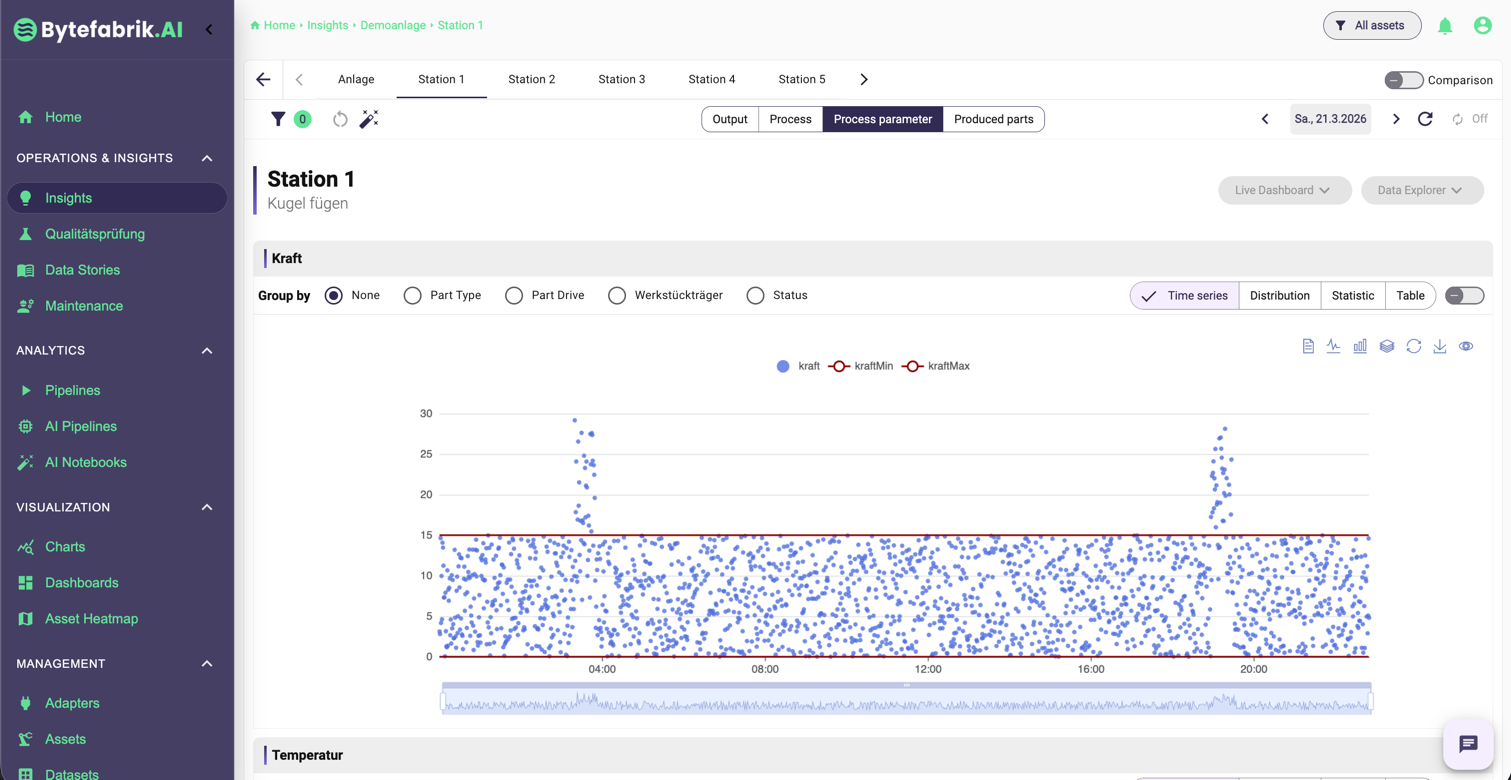
These issues often take center stage in discrete manufacturing environments.
Detect deviations in cycle time, waiting times and station cycles.
Link quality events with process data and product reference.
Consider each produced part in the context of station, process and limit values.
Evaluate recurring patterns not in isolation, but in the production process.
The solution is usually not used as an isolated dashboard, but as an analysis environment that enables teams to take robust measures step by step.
At the beginning, it is clarified which lines, stations and quality or availability issues are to be considered.
Control, sensor and product data are linked in such a way that they can be assigned to lines, processes, products and shifts.
Teams use the evaluations to narrow down bottlenecks, quality losses or recurring error patterns.
Depending on requirements, traceability, process analysis, data stories or AI modules are added on the same basis.
Basis for reliable production analyses
Existing control and process data is usually sufficient for production-related root cause analysis if it is combined correctly.
These types of data are particularly important in discrete production environments in order to evaluate deviations in a traceable manner.
Statuses such as processing, automatic operation, stops or station events form the basis for availability and sequence analyses.
Force, displacement, temperature, torque, tightness or other quality-relevant values make process behavior technically evaluable.
Product IDs, batches, workpiece carriers or variants allow the linking of process history and quality per part.
IO, NOK and rework information link quality events with the underlying production context.
Function modules for different tasks
Depending on the line structure and data situation, different modules can be combined to specifically cover process, quality and product issues.
These functional areas can be combined within the same platform.
For output, cycle times, quality curves and the structured evaluation of line and station data.
If real process paths, variants and loops are to be traceable across several stations.
For parts histories, traceability and access to product-related process and quality data.
For the structured evaluation of warnings, error codes and fault patterns during operation.
Demo
Arrange a demo to get to know the platform, analysis and AI functions based on your questions.